The
Computer System Concept.
A
computer is more than a high-powered collection of electronic devices
performing a variety of information processing chores. A computer is a system,
an interrelated combination of components that performs the basic system functions
of input, processing, output, storage, and control, thus providing end users
with a powerful information processing tool. Understanding the computer as a
computer system is vital to the effective use and management of computers.
A
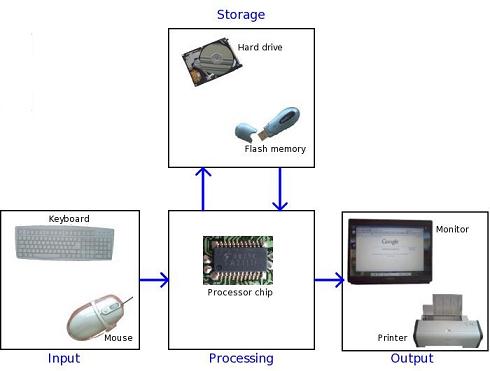
computer is system of hardware devices organized according to the following
system functions.
- Input. The input devices of a computer system include
keyboards, touch screens, pens, electronic mice, optical scanners, and so
on.
- Processing. The central processing unit( CPU) is the main
processing component of a computer system. (In microcomputers, it is the
main microprocessor.) In particular, the electronic circuits of the
arithmetic-logic unit one of the CPU’s major components, perform the
arithmetic and logic functions required in computer processing.
- Output. The output devices of a computer system include video
display units, printers, audio response units , and so on, They convert
electronic information produced by the computer system into human
intelligible form for presentation to end users.
- Storage. The storage function of a computer system takes place
in the storage circuits of the computer’s primary storage unit, or memory,
and in secondary storage devices such as magnetic disk and tape units.
These devices store data and program instructions needed for processing.
- Control. The control unit of the CPU is the control component
of a computer system. Its circuits interpret computer program instructions
and transmit directions to the other components of the computer system.
The
Central Processing Unit.
The
central processing unit is the most important hardware component of a computer
system. It is also known as the CPU, the central processor or instruction
processor, and the main microprocessor in a microcomputer. Conceptually, the
circuitry of a CPU can be subdivided into two major subunits the
arithmetic-logic unit and the control unit. The CPU also includes circuitry for
devices such as registers and cache memory for high –speed, temporary storage
of instruction operations, input/output, and telecommunications support.
The
control unit obtains instructions from software segments stored in the primary
storage unit and interprets them. Then it transmits electronic signals to the
other components of the computer system to perform required operations. The
arithmetic-logic unit performs required arithmetic and comparison operations .A
computer can make logical changes from one set of program instructions to
another (e.g, overtime pay versus regular pay calculations) based on the
results of comparisons made in the ALU during processing.
Main
Memory and Primary Storage Unit.
A
computer’s primary storage unit is commonly called main memory, and holds data
and program instructions between processing steps and supplies them to the
control unit and arithmetic-logic unit during processing. Most of a computer’s
memory consists of microelectronic semiconductor memory chips known as RAM
(random access memory ). The contents of these memory chips can be instantly
changed to store new data. Other, more permanent memory chips called ROM (read
only memory) may also be used.
Secondary
storage devices like magnetic disks and
optical disks are used to store data and programs and thus greatly enlarge the
storage capacities of computer system. Also, since memory circuits typically
lose their contents when electric power is turned off, most secondary storage
media provide a more permanent type of storage. However the contents of hard
disk drives floppy disks, CD-ROM disks, and other secondary storage media
cannot be processed without first being brought into memory. Thus secondary
storage devices play a supporting role to the primary storage of a computer
system.
Multiple
Processors.
Many
current computers, from microcomputers to large mainframes, use multiple
processors for their processing functions. Instead of having one CPU with a
single control unit and arithmetic-logic unit, the CPUs of these computers
contain several type of processing units. Let’s briefly look at the major types
of such multiprocessor designs.
A
support processor design relies on specialized
microprocessors to help the main CPU perform a variety of functions. These
microprocessors may used for input/output, memory management, arithmetic
computations, multimedia processing, and telecommunications, thus freeing the
main processor to do the primary job of executing program instructions For
example, many microcomputers rely on support microprocessors such as arithmetic
co-processing load on their main microprocessors. A large computer may use
support microprocessors called channels to control the movement of data between
the CPU and input/output devices. Advanced microprocessor designs integrate the
functions of several support processors on a single main microprocessor.
A
coupled processor design uses multiple CPUs or main
microprocessors to do multiprocessing, that is, executing more than one
instruction at the same time. Some configurations provide a fault-tolerant
capability in which multiple CPUs provide a built-in backup to each other
should one of them fail.
A
parallel processor design uses a group of instruction
processors to execute several program instructions at the same time. Some
times, hundreds or thousands of processors are organized in clusters or
networks in massively parallel processing (MPP) computers. Other parallel
processor designs are based on simple models of the human brain called neural
networks. All of these systems can execute many instructions at a time in
parallel. This is a major departure from the traditional design of current
computers, called the Von Neuman design, which executes instructions serially
(one at a time). Though difficult to program, many experts consider parallel
processor systems the key to providing advanced capabilities to future generations
of computers.
RISC
Processors. Many advanced
technical workstations and other computers rely on a processor design called
RISC (reduced instruction set computer). This contrasts with most current
computers that use CISC (complex instruction set computer) processors. RISC
processor designs optimize a CPU’s processing speed by using a smaller
instruction set. That is, they use a smaller number of the basic machine
instruction that a processor is capable of executing. By keeping the
instruction set simpler than CISC processors and using more complex software, a
RISC processor can reduce the time needed to execute program instructions.
Computer
Processing Speeds.
Computer
operating speeds that were formerly measured in milliseconds (thousands of a
second) and microseconds (millionths of a second) are now in the nanosecond
(billionth of a second) range, with picosecond (trillionth of a second)
speed being attained by some computers. Such speeds seem almost
incomprehensible. For example, an average person taking one step each
nanosecond would circle the earth above 20 times in one second. Many
microcomputers and midrange computers, and most mainframe computers, operate in
the nanosecond range, and can thus process program instructions at million
instructions per second (MIPS) speeds. Another measure of processing speed is
megahertz (MHs), or millions of cycles per second. It is commonly called the
clock speed of a microprocessor, sine it is used to rate microprocessors by the
speed of their timing circuits or internal clock.
However,
megahertz, ratings can be misleading indicators of the effective processing
speed of microprocessors as measured in MIPS and other measures. That’s because
processing speed depends on a variety of factors besides a microprocessor’s
clock speed. Important examples include the size of circuitry paths, or busses,
that interconnect microprocessor components, the capacity of instruction
processing registers, the use of high-speed memory caches, and the use of
specialized microprocessors such as a math co-processor to do arithmetic
calculations faster. For example, Intel’s Pentium microprocessor runs at 66 to
200 MHz and is rated at over 100 MIPS, which the Pentium Pro microprocessor has
a top processing rating of over 200 MIPS at similar megahertz speeds.
